The Proportion Rule That Makes Every Outfit Look Wrong
Learn to judge outfit proportion by comparing its own lengths and volumes, so you can adjust a hem, layer, or shoe without obeying a fixed formula.
Why does a proportion rule make an outfit feel wrong even when its pieces seem to follow the rule? Often, the rule has replaced observation: it prescribes where a hem should fall or how a top should relate to trousers without considering the clothes actually being worn. Outfit proportion is more useful as a comparison among lengths and volumes within the outfit itself.
Rules miss the outfit
Rules such as “short over long” or “divide the body into thirds” can be useful prompts, but they are not verdicts. A cropped jacket over full-length trousers creates one relationship; the same jacket over a skirt that ends near the knee creates another. Neither can be judged from the top alone.
The visual effect also depends on where the garment ends in relation to the next one. A sweater hem may sit just above a trouser waistband, cover it, or stop midway over the hip. Those positions change how the outfit reads, even if the sweater itself has not changed.
Try asking what the clothes are doing together before asking whether they obey a formula. Is one length clearly dominant? Do two hems meet in a way that feels deliberate, or do they compete for attention?
Read the hem sequence
Start with the visible horizontal lines: shirt hem, jacket hem, trouser break, skirt hem, and boot or shoe opening. The eye tends to notice these as a sequence. Closely spaced lines can make the lower half feel busy; a long uninterrupted span may make a short upper layer look more emphatic.
That does not mean every hem needs distance from the next. A shirt tucked into trousers removes one line from view, while an open jacket creates vertical edges that guide the eye past its hem. A long coat over a shorter skirt can work because the coat supplies a clear outer length rather than leaving the skirt hem to carry the whole composition.
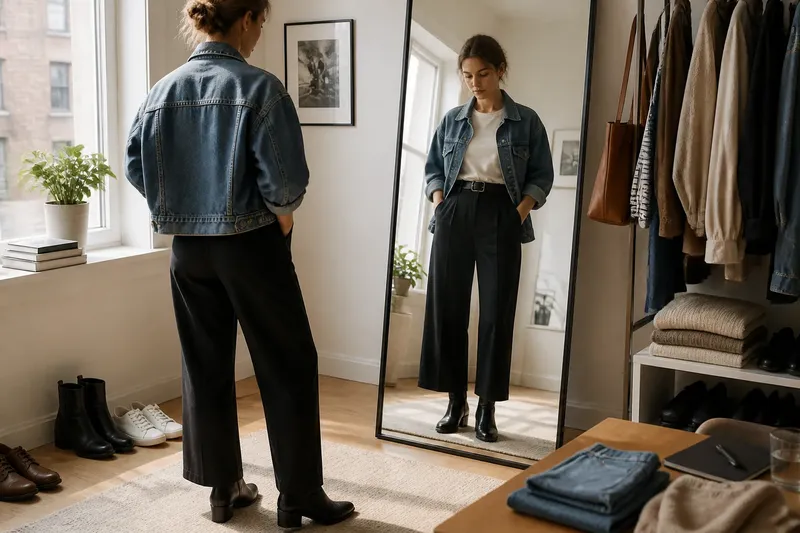
Say you have a boxy denim jacket, straight dark jeans, and ankle boots. If the jacket and jeans both end at visually prominent points near the hip and ankle, the outfit may feel divided into disconnected blocks. Imagine leaving the jacket open over a tucked-in shirt; the exposed vertical line and cleaner waist break may make the same pieces read as a continuous outfit. The useful observation is not “open jackets are better,” but that the visible lines changed.
Compare volume honestly
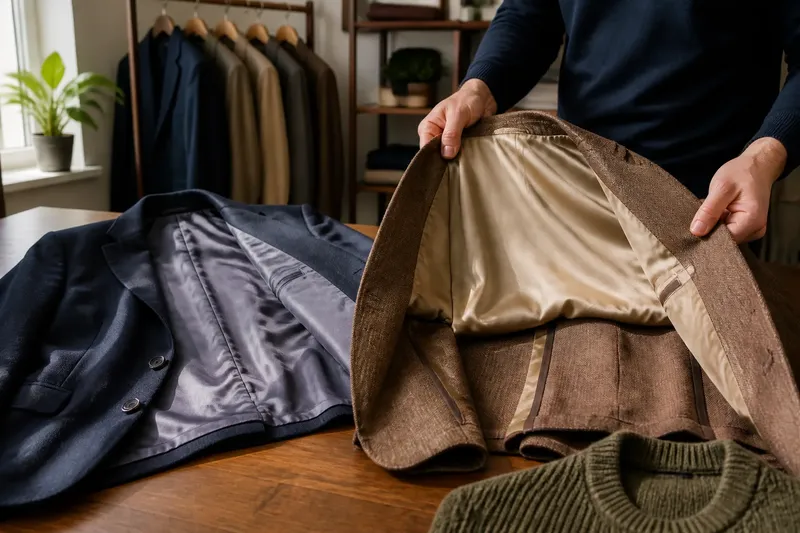
Volume is not the same as size. A wide trouser leg may fall cleanly from the hip, while a narrow leg may bunch at the ankle; the first can look quieter despite taking up more space. Fabric weight, stiffness, drape, and gathering all affect the outline.
Compare the broadest areas rather than judging each item in isolation. If a voluminous sleeve meets a full skirt, the outfit has substantial volume above and below the waist. That can look balanced when the shapes are distinct, or crowded when both fabrics puff and gather in the same way.
A slimmer layer can create contrast, but it is not a mandatory correction. A fluid blouse under a structured blazer separates soft movement from a firm outline. Two relaxed pieces can also work if their fabrics fall differently: for example, a soft knit with crisp cotton trousers gives the eye two kinds of volume to read.
When an outfit feels heavy, identify where the bulk actually sits. A bulky sweater tucked into thick denim may concentrate it at the waist; a longer sweater worn untucked may distribute the same visual weight across the torso. The right choice depends on whether you want to define that area or let the layers read as one column.
Use the mirror as a tool
A full-length mirror helps, but the useful question is specific: where does the eye stop, and what shape does it notice first? If a coat seems to swallow an outfit, check whether its hem, sleeve width, and lapels all dominate at once. If a skirt looks oddly short, compare its hem with the top of the boot and the hem of any outer layer.
Change one variable at a time. Untuck the shirt, then look again; switch the shoe, then look again. Changing the top, trousers, belt, and shoes together makes it difficult to tell which relationship changed. A phone photograph from a normal standing distance can be useful when the mirror view feels distorted by close inspection.
Also check the outfit in motion. A slit, wide leg, or long open layer can alter the outline when walking or sitting. A static pose is only one view of clothing, and garments are not obliged to remain in it.
What should you compare?
Where should a jacket hem fall?
Compare it with the waist, hip, and hem of the layer beneath rather than aiming for one prescribed point. A jacket that ends near a trouser pocket may emphasize that line; one that extends lower may connect more clearly with a longer base layer.
Can oversized clothes look balanced?
Yes, if the outline has some legible structure, such as a clear shoulder, a visible wrist, or a deliberate difference between top and bottom volume. Several oversized pieces with similar stiffness can blur into one large shape, so changing fabric or length may help.
Do shoes change outfit proportion?
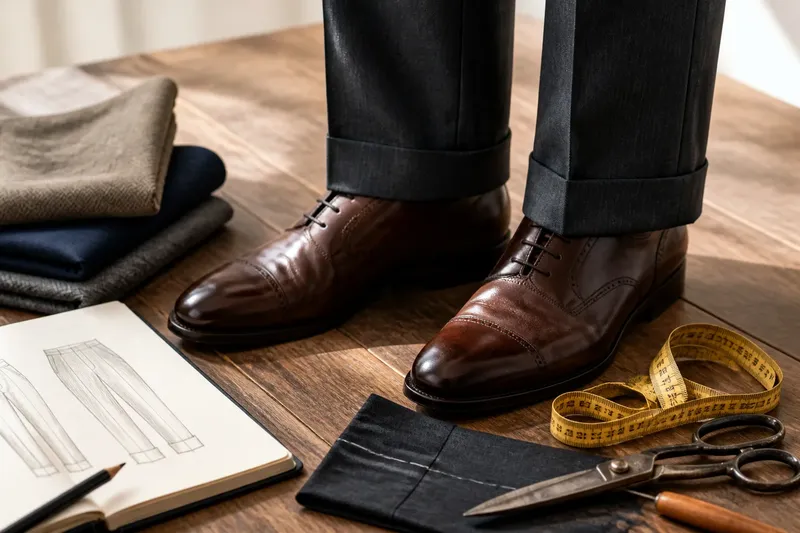
They can, because a shoe adds a visible endpoint to the leg and may meet a trouser or skirt hem closely. Compare the shoe opening, trouser break, and hem as a group instead of treating footwear as a finishing detail outside the composition.
Does the rule change by body type?
Fixed body-type rules often make proportion harder to read by sending attention to supposed flaws instead of the clothes’ relationships. Start with the outline you want from the outfit, then adjust lengths and volume to support it.
Make one useful adjustment
When a look seems off, name the mismatch before reaching for a new garment. You might find that the top and outer layer end almost together, that two wide shapes meet without a clear break, or that a heavy shoe sits under a very delicate hem. These are observations, not errors that must be corrected.
Try a small, reversible change: roll a cuff, open a front, tuck only the front of a shirt, or swap to a shoe with a different profile. Then check the whole silhouette again. If the outfit reads more clearly, keep the change; if not, return to the original and test another relationship.
For a deliberate proportion, consistency matters more than compliance with a universal ratio. Notice which length leads, which volume supports it, and where the eye travels next. That is a more reliable way to judge outfit proportion than asking whether a formula says your hem belongs somewhere else.