Why a Jacket Lining Changes the Way a Garment Sits
Learn how a jacket lining affects its feel, drape, coverage, and movement so you can judge whether a lined or unlined style suits your needs.
Why does one jacket glide over a shirt while another catches at the elbows or pulls across the back? The lining is often part of the answer. A jacket lining is the layer inside the shell, and its coverage, fabric, and room to move can change how the jacket feels and hangs without changing its outer appearance.
To judge a jacket well, look beyond the question of whether it is lined. Notice where the lining ends, how it behaves when you move, and whether its surface suits the clothes you expect to wear beneath it. Those details explain more than a simple lined-or-unlined label.
Start with the inner layer
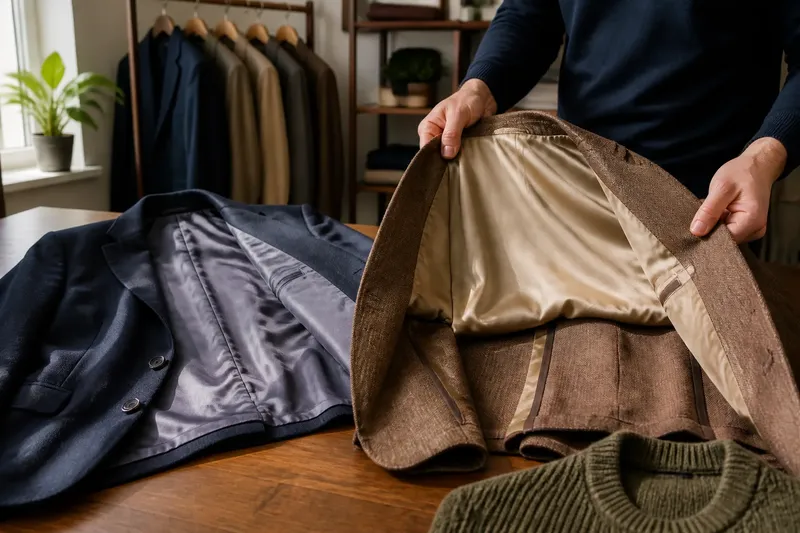
Turn the jacket inside out if the garment allows it, or open it wide and inspect the interior. A lining may cover nearly the whole body, appear only across the back or sleeves, or be absent. Some jackets have a loose inner panel across the shoulders, often called a half lining, while others use a partial lining that leaves sections of the shell exposed.
The lining is not merely a decorative interior. It creates a smoother surface between the jacket shell and the clothes underneath, can help the garment pass over a shirt or sweater, and conceals interior seams. Depending on its construction, it may also give the shell a more orderly inner finish. It does not, by itself, make a jacket warm; insulation, shell fabric, fit, and the clothes beneath all matter.
Look at the label for fiber content, and check whether the lining is attached through the sleeves as well as the body. Polyester, cupro, viscose, silk, and other fibers have different textures and care needs. The fiber name alone does not tell you how the garment will move, so handle the lining gently and observe its surface and flexibility.
Trace the coverage
Follow the lining from the shoulders downward. A full lining usually extends through the body and sleeves. A partial design leaves some of the body unlined, while a back-only panel may cover the upper torso and leave the lower front and sides open. Each arrangement changes which parts of the jacket have a smooth inner layer.
Coverage matters most at contact points. Sleeve lining can help a jacket slide over a knit cuff; a lined back can reduce friction against a shirt. Where the lining stops, the shell fabric touches the clothes beneath. That may feel unremarkable in a loose, smooth jacket, but more noticeable if the shell is textured or the underlying layer has a soft knit surface.
Inspect the hem and lining edge. A separate, free-hanging lining is designed to move somewhat independently from the shell. A lining caught tightly at the hem can restrict that movement or make the lower edge feel firm. Neat stitching and a little ease are more useful signs than an interior that looks perfectly taut while the jacket lies flat.
Check the back vent, side vents, and front opening too. The lining should not obscure how these features are finished or appear to pull them closed. A vent that sits flat while the jacket hangs may separate naturally during movement; a lining that strains across it can make the back look unsettled.
Check the fabric interaction
Think about what the jacket will sit over. A slick lining generally glides more readily over a shirt or fine knit than a rough interior surface. If you often wear a sweater with a nubby texture, try the jacket over a similar layer rather than judging it over a thin shirt. A lining that feels smooth against bare fingers may still catch on a textured sleeve.
The shell matters just as much. A soft, unstructured jacket may rely on a light lining or partial coverage to keep its easy character. A heavier or more tailored shell may use a fuller lining to cover seams and create a finished interior. These are tendencies, not rules: the pattern, fabric, and construction determine the result together.
Imagine you are choosing between two casual jackets for regular wear over a wool sweater. One has a smooth sleeve lining and an unlined body; the other has a rougher interior throughout. Try both with the sweater, lift your arms, then lower them. If the first slides at the sleeves but feels comfortable across the back, its partial coverage may suit your usual layers better. The point is not that partial lining is always superior; it is that the actual contact between layers is easy to assess.
Watch it move
Put the jacket on over the kind of top you expect to wear. Close it if that is how you normally use it, then reach forward, sit, and raise your arms as if taking something from a shelf. Watch the lining through the opening and feel for catching at the elbows, shoulders, or lower back.
A lining should not need to lie perfectly smooth during every movement. The useful question is whether it returns to place without pulling the shell into folds or making the jacket twist. Check the shoulder seams and sleeve openings after moving. If the lining has ridden up inside the sleeve, or the body lining has gathered sharply at the waist, the garment may feel less composed in ordinary use.
Now let your arms hang naturally and view the jacket from the front and side. Notice whether the front edges fall evenly and whether the back settles rather than clinging to the shirt. A lining with too little ease can tug at the shell; a lining that is excessively loose may bunch. Either issue can be affected by the jacket’s overall fit, so do not assign every wrinkle to the lining.
Choose coverage for use
For a jacket worn over smooth shirts, a partial lining may provide enough glide while keeping the interior less enclosed. If the jacket will often go over sweaters or long-sleeved layers, sleeve coverage can make dressing and movement more comfortable. A full lining may appeal if you want seams covered and a smooth inner finish, but its presence is not a reliable measure of warmth.
For warm-weather wear, an unlined or lightly lined jacket may feel less enclosed, especially when its shell is breathable. Yet a dense shell can still feel warm, and a lining made from a light, breathable fabric may be comfortable. Consider the whole garment rather than treating “unlined” as a promise of coolness.
Care is another practical difference. A lining can complicate cleaning because its fiber and construction may call for different treatment from the shell. Read the garment’s care label and follow the manufacturer’s instructions; where those instructions leave a material question unresolved, ask a qualified cleaner familiar with the garment.
Common lining questions?
Does a jacket need a lining?
No. An unlined jacket can have a clean finish and feel less enclosed, while a lined one may glide more easily over layers and conceal seams. The better choice depends on the shell, construction, and clothes you plan to wear with it.
Does a full lining make a jacket warmer?
It can add a layer between you and the shell, but warmth depends on the fabrics and construction as a whole. A thin lining in a lightweight jacket is not a substitute for insulation or a suitable outer layer.
Why does my jacket lining bunch up?
Fabric can shift during wear, but sharp gathering or persistent pulling may indicate that the lining has too little ease, has become twisted, or is interacting poorly with the layer beneath. Check whether the shell also pulls before deciding that the lining alone is responsible.
Can a tailor change the lining?
A tailor may be able to repair or replace a lining, but the work depends on how the jacket is built and whether suitable fabric is available. Ask for an assessment before treating alteration as a simple fix, since the lining can be connected to the jacket’s shape and finish.
Make the final call
Before deciding, match the jacket to its ordinary job: the shirt or sweater beneath it, the movements you make in it, and the amount of interior coverage you prefer. Open the jacket, inspect the lining’s edges and vents, then wear it and move. Those checks reveal whether the lining supports the jacket’s intended ease or gets in its way.
A jacket lining is a small interior decision with a visible effect: it can change how the shell slides, settles, and presents itself after movement. When comparing jackets, ask where the lining is, what it touches, and whether it returns to place. That is a more useful question than whether the jacket is lined at all.